


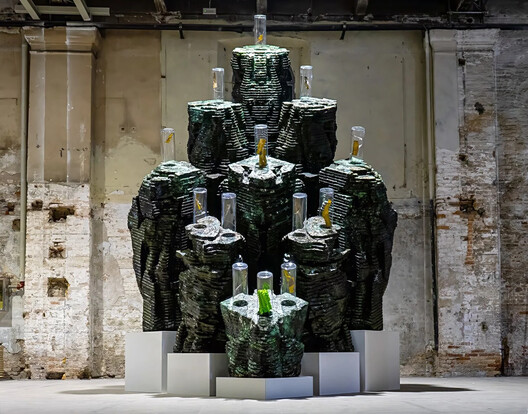
This curated selection of projects from the 2025 Venice Architecture Biennale explores how architects and designers are rethinking the relationship between the built environment and water in response to the global climate crisis. As sea levels rise and extreme weather events increase, water is no longer a distant threat but an immediate design condition. Rather than resisting it, these projects look at how architecture can coexist with, adapt to, and even regenerate through natural forces. Together, they suggest a shift toward working with the elements, acknowledging water not as a limit to construction but as an active participant in shaping future environments.




The selected projects take diverse approaches. The Biorock Pavilion proposes growing architecture directly in seawater through mineral accretion, while Coding Plants imagines an artificial reef and living kelp archive as a new kind of biological infrastructure. Meanwhile, Building Amphibious Natures focuses on wetland restoration in and around the Venice Lagoon, showing how design can support ecological regeneration. Cultivating in Shallow Waters revisits the saltworks of Messolonghi in Greece as a model for productive coexistence between humans and aquatic systems. Other works, such as Hope on Water and Ocean City, explore adaptable and resilient structures that can function on land or water, and Sea Oasis introduces AI-driven tools for marine restoration through 3D-printed oyster reefs. Seen together, these projects highlight an emerging focus on how architecture can operate within fluid environments and contribute to the balance between human and ecological systems.


